

Interface and Infrastructure
A hackathon story with lasagna prompts and who gets to choose their future.

A few weeks ago, I attended a hackathon at a space I knew well, looking out at a view from the 60th floor that I’ve admired for many years, sitting with a tool I’d already pushed to its limits, in a room full of people trying to become something.
From a distance, it photographed well. AI event, big names, expansive views. From up close, it was an identity shaping event for people trying to decide what kind of work and life they want.
The invite promised:
If you can prompt ChatGPT to make lasagna, you can totally vibe-code an app in Lovable.
I laughed out loud. The event was for the finance team. I pictured finance people microwaving apps that touch real money and data, with no idea where the meter runs or what happens when the cloud space maxes out.
I had already built an expense dashboard and a diagnostic tool, and learned the hard way that underneath the easy interface there is migration work, credit overages, and a database waiting for you to figure out.
My table was its own little ecosystem.
A recent computer science grad, job‑hunting for a few months, trying not to get depressed at home refreshing LinkedIn.
A woman who disliked her current work environment and was plotting an exit.
Two startup guys vibe‑coding another prototype, barely interacting with anyone but their laptops.
A CFO of a SaaS company who had been wandering the building and popped in to see what was happening.
Me, the person making connections happen between people who might otherwise never speak.
The grad and I sat next to each other and started talking. He noticed my app and asked what I was building. I noticed that his was done while everyone else was trying to figure out how to apply Lovable credits. He said he was going to record a tutorial for it too. He also asked about my charger:
Why don’t you use the magnetic one?
I don’t know, I said. I guess I’m practical about using one for my laptop and my phone. Why?
If someone trips over your wire, it snaps off, it won’t send your laptop flying. He explained calmly.
He was one of those optimized, detail-oriented people, which I honestly don’t encounter much. When the jelly beans pockets came around, I grabbed them while working on my app.
Careful… he said smiling, and pointed at the instructions: Use it during financial stress.
I laughed.
He made sure we went to get food together and offered help with Loom and YouTube. He was accommodating in a way that felt caring, not performative.
We talked about the vibe-coding. The interface was just a shiny object. If you wanted to connect anything underneath, it was more work and required understanding of how the pieces fit together.
He smiled again and said:
That’s where I come in, most of the people here don’t know how.
I agreed. We had been told told that if we could make lasagna, we could build an app, while offloading the complexity onto people like him whose entry level jobs were the first to be squeezed by the same tools.
We also talked about New York.
I’ve already had my life here, I said, I wouldn’t mind moving if my work location was flexible.
He looked at me like I had said something outrageous.
New York is the best place to be! How could you ever leave?
He is at the stage where living in a big, busy city, making money and hanging out is exciting. I am at the stage where I dream about a small house in nature, by the water.
He’s thinking about AI eliminating the roles he’d trained for. I am thinking about where I actually want to spend my energy.
We met in the same city from completely different identity and life stages.
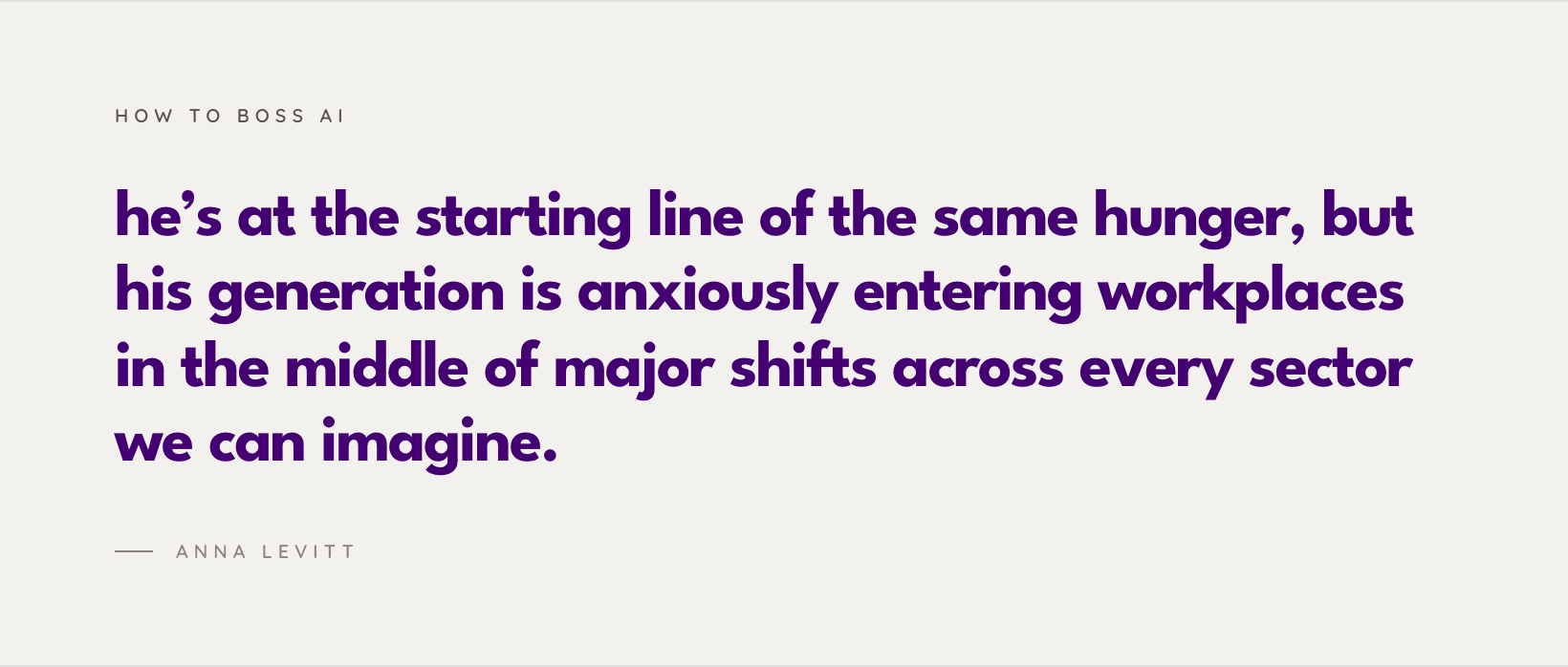
I thought about how fortunate I was to have had that chapter of my career. I lived the life he wanted, the fancy offices and leadership roles. He’s at the starting line of the same hunger, but his generation is anxiously entering workplaces in the middle of major shifts across every sector we can imagine.
At the table, the woman across from us said she did not want to be at her job anymore. She came to the hackathon to learn how to take her Google Doc pages and turn them into a platform so she could transition to her own company.
We spoke about entrepreneurship and how much it takes to switch your mindset from an employee to working on your own. Her company was still a fantasy but the prototype she built was promising. The space was exactly where she needed to be to learn and prove herself.
The CFO roamed the room. He came over and said hi, casually curious. I asked him what brought him in; he said he had popped in because he was around. He had taken over a company with an offshore team and didn’t like how it operated. He was open, listening, and taking numbers. A decider on the fly, figuring out which of his problems this room was solving.
The grad knew how to connect the dots from data migration to token usage, working comfortably across the AI infrastructure. He was applying on LinkedIn and hoping he would get chosen from thousands of others, but there was a bigger constraint. He needed a door that would open and secure his visa to stay in the city he called home.
A few yers ago, I would have walked out of that place and started making calls to get the grad a job. I’d spend time reaching out to contacts and sending his resume. I lived a lot of my professional life that way: the person who notices a need and immediately scans for a solution.
This time, I turned to him and said:
Talk to this CFO, he might be looking for people.
Then I stopped there and let their stories be their own. I didn’t use my nervous system as free infrastructure for every room I walked into.
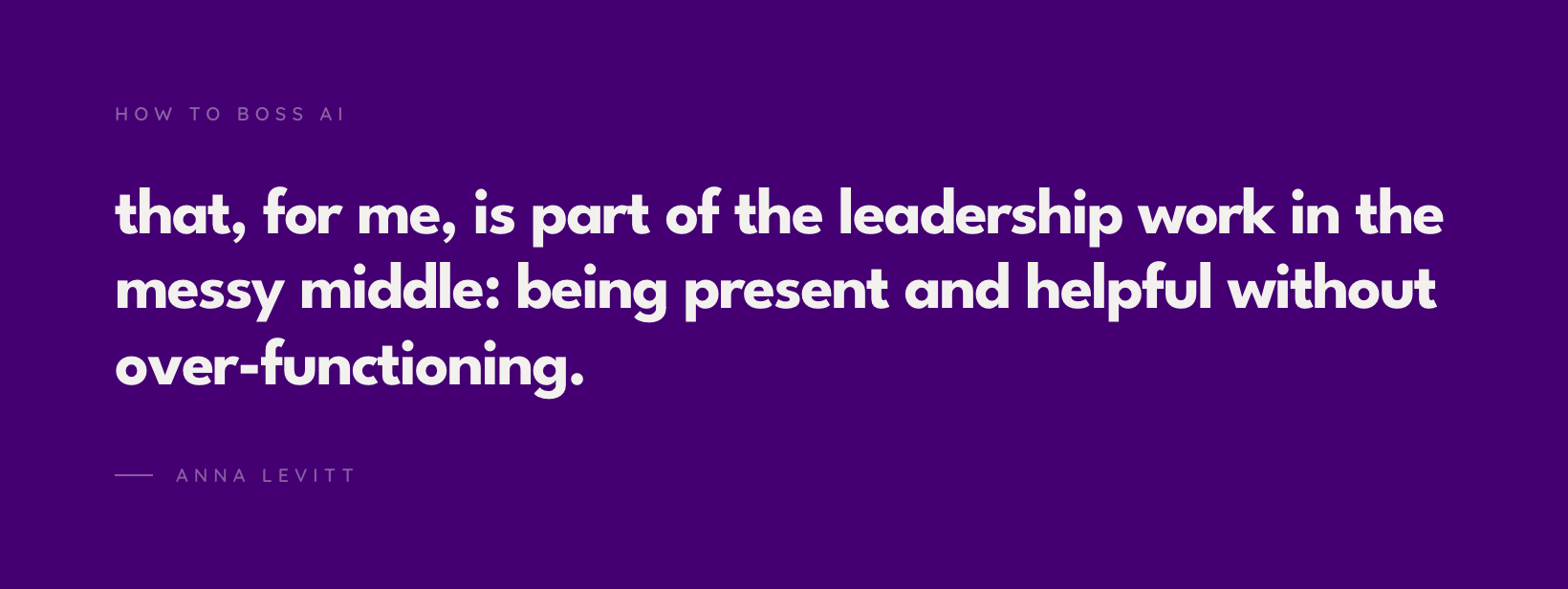
That, for me, is part of the leadership work in the messy middle. Being present and helpful without over‑functioning. Creating contact, passing along resources, and trusting other adults to figure out the rest.
Put these people at one table and you get a cross‑section of AI‑era work: authority, infrastructure, escape plans, and quiet observer. The person who decides does not yet understand the tool. The one who understands the tool does not decide whether his role survives. Another, who wants to go on her own, and me, a witness and connector.
People don’t need more advice. They need a place to practice in, see what they are capable of, break things, deal with friction. The grad needed a space where he could show another human how to take an app from a prototype to a functioning product. The woman needed a container where she could say out loud that she wants to go on her own. The CFO needed a room with the talent and skill in front of him.
Leading beyond 2026 is not just leading with AI tools. The work of keeping organizations running is happening on different floors than the decisions. The entry-level engineers migrating data and the mid-level managers keeping teams sane while the top runs another AI event.
That grad at my table was the infrastructure. The woman, holding her environment together while plotting her exit was the infrastructure. The CFO had the authority to hire and decide what the organization buys.
If we think about what’s next, it’s not about choosing the right tool from above. It’s about understanding how these people and tools come together as a cohesive place called work.
Events like hackathons show people that they could create a functioning app and use it in two hours but they don’t address the infrastructure, the cost associated with it, the knowledge needed to troubleshoot it and, an audience that will use it. When these are skipped, you sell the product that hasn’t been validated. Some people in that room understood that; some didn’t.
There was another event for vibe-coding voice agents. I skipped it and went to a live performance instead.
The grad couldn’t make that choice. He had to perform being there because his immigration status and the job hunt depended on staying visible. I got to opt out because I already built the visibility. That is a career stage. It is worth noticing who has room for discernment and who is required to show up.
The future of work is not only about tools but also about who gets to choose, and who doesn’t.
To get to the hackathon, you do the classic New York office dance. Scan the badge, navigate the turnstiles, pass commissioned art on the walls, take in the views and impressive logo signage.
On the way down, the elevator filled up with people staring at their phones, doom-scrolling, bodies tilted toward the doors, counting the seconds until they could get out.
We talk about AI and the future in these spaces, but a lot of people inside them are just trying to survive the present.
A lot of the buildings in New York are places my previous company helped finish. It’s strange to be in these rooms from a different perspective. I keep coming back, one foot in something I built, one in what I’m building now, and noticing who wants to be there and who is tilted toward the door.
If you recognize yourself in this essay, this is the work I do with people who are done being the invisible infrastructure. I help people move from over‑functioning in other people’s systems to designing their own.

ai compass read the room before you rewire it. → try the free assessment
culture workshops build the container before the pressure arrives.
focused sessions for leadership teams and managers on the human dynamics that make or break AI rollouts: identity, trust, communication, and what it actually means to lead when some of your team members are agents. → let’s talk
executive advisory & coaching for the decisions and the identity crisis underneath them.
a partnership for founders and executives navigating transformation. sometimes the work is strategic: governance, decisions, what to build next. sometimes it’s personal: who you are becoming, what you still own, what’s worth protecting. usually it’s both at once. → book a conversation
The lasagna analogy is funny because it describes the current AI moment 10/10. Everyone is being told they can cook. Fewer people are talking about the supply chain, the kitchen, the ingredients, the food safety, the spices, and who cleans up afterward.
PS, I regret leaving NYC almost every single day. It's been 8 years now. You would think I would get over it. LOL
Happy Monday, Anna.
Anna, this post has so many beautiful, profound moments in it. I love that you still helped the grad and made a connection, but you were able to leave it at a single moment of introduction. The way you reflect on these events and the learnings you take from them are so very cool.
My very first corporate job had an elevator that sat underneath a rooftop swimming pool and because of the way it had to be made safe, it was incredibly slow. The awkward elevator chat and waiting was sooo drawn out and people literally tumbled out and ran from it when it finally opened on a floor. Your mention of one at the end brought back so many memories!