

Extended Intelligence
Reggie Watts and the question the research keeps answering so I made a tool for it.

The first time I heard the phrase, a man wearing headphones was making a machine sing.
At the Shared Futures 2026 festival in New York, Reggie Watts walked out, put on headphones like it was standard industry procedure, his joke, and started looping his own voice into a song that made no sense and complete sense at the same time.
Somewhere between beats he dropped it:
I don’t call it artificial intelligence. I call it EI, extended intelligence, because when I’m using it, it feels pretty real.
The room moved on. The phrase stuck with me.
Reggie wasn’t the first to reach for it which I learned later.
Joi Ito, then directing the MIT Media Lab, helped articulate the term in his 2017 manifesto Resisting Reduction, his counter to the Singularity story where machines outgrow us and solve everything. His objection to artificial intelligence was almost word for word Reggie’s:
The adjective is wrong, it frames the system as standing outside of us, when the intelligence only exists in the network of humans and machines together.
Pull the thread further back into sixties and you reach Licklider’s man-computer symbiosis and Engelbart trying to augment human intellect instead of replacing it. The phrase keeps getting reinvented because the need for it is not going away. An engineer in 1960, an MIT director in 2017, an artist mid-loop in 2026, all using the same expression.
What stayed wasn’t just the words, it was the demonstration running underneath them. The machine was looping his voice, layering it, holding what he gave it, creating visuals and he was deciding every beat that stayed his. None of us in that room watched Reggie Watts and wondered whether the machine had replaced him.
The machine was making him more Reggie, not less.
Later, the phrase came out of me on the fly and I posted it on Substack with no framework or plan behind it:
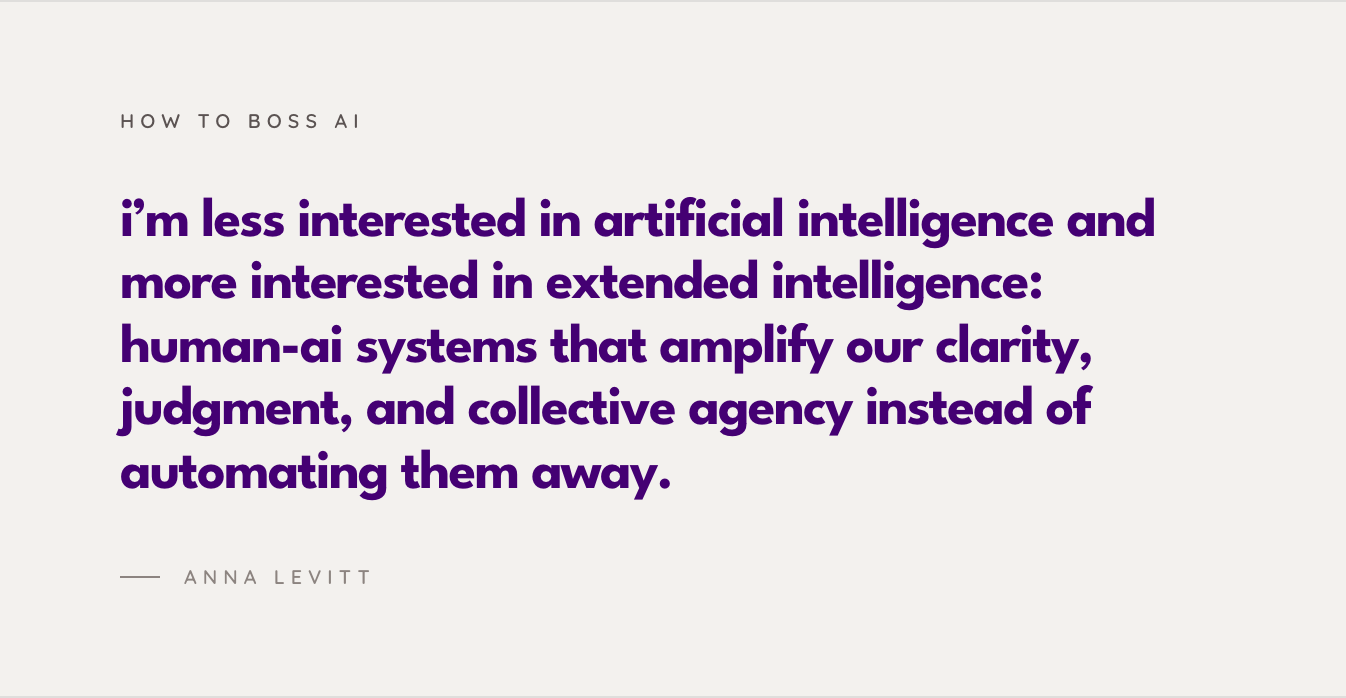
It went further than I expected. Fifty replies and reading through them I noticed something that had nothing to do with agreement.
People weren’t saying good point. They were saying finally, a name for it.
A dyslexic novelist, Carl Freeman wrote about AI as the bridge between his thinking and the page. Others described using it to sharpen questions and decisions rather than make them. People described a similar relationship: the tool as an extension of their own cognition. The relief people felt at having language told me the anxiety was already there, unnamed.
Am I still the one thinking?
The question was already circling before the note. Mia Kiraki and I had just written about borrowed thinking, running someone else's pattern without checking whether it fits your situation, and how it never feels borrowed while it's happening. It feels like strategy: whose question you were asking in the first place.

While the comments kept coming, I was reading through Microsoft’s 2026 Work Trend Report and few findings, not surprisingly, stood out.
They identified a group they call Frontier Professionals, about 16% of AI users, who drive most of the organizational value from AI. What makes them different isn’t prompting skills or tool knowledge.
They refuse to outsource their thinking.
Two behaviors define them. They are 1.43x more likely to deliberately work without AI to keep their own skills sharp, 43% against 30% for everyone else. They are 1.6x more likely to pause before a task and decide whether it should go to AI at all, 53% against 33%.
The people getting the most out of AI are the ones who most deliberately keep parts of their work away from it.
That’s the whole extended intelligence thesis in data. The value comes from deliberate routing, the pause where you decide what stays yours. The research calls it taste. I’d say is the moment your agency either shows up or doesn’t.
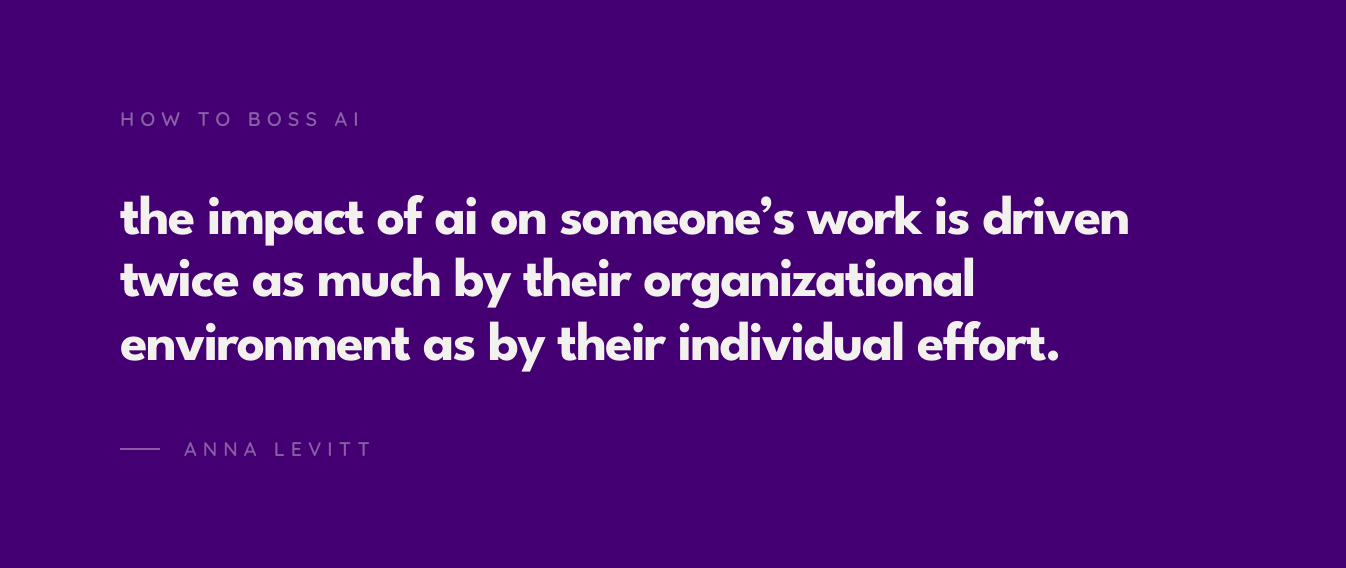
One more number from that report. The impact of AI on someone’s work is driven twice as much by their organizational environment as by their individual effort, roughly 67% to 32%. Which means the drift I’m describing isn’t a personal failure. It’s what happens when a frictionless tool meets a workplace that rewards output speed and never asks who did the thinking. 65% of workers say they’re ready to reinvent how they work. 13% feel rewarded for doing so. The gap between those numbers is where most of the damage happens.
The affirming replies felt good. Two critical ones did more.
The first asked:
Where’s the boundary once the system doesn’t just advise but acts?
Fair. Agents are executing multi-step work on their own now. Calling that an extension of you gets philosophically slippery when you weren’t in the loop for steps two through six.
My answer, for now:
The extension isn’t in the execution, it’s in the routing.
You extended your intelligence when you decided what to delegate and kept the review. You got automated away the day the delegating stopped being a decision and became a default.
The second critique runs deeper:
AI amplifies whatever you bring it. Weak thinking amplified is weak thinking at scale, with better formatting. Confusion in, confident confusion out.
This one I fully accept, and it’s why extended intelligence can’t just be a nicer word for AI adoption. Extension is not a property of the tool. It’s a property of the practice. The same chat window that sharpens one person’s judgment replaces another’s, and from the outside, from the output, you cannot tell which is happening.
You can only tell from the inside. Which is a problem, because from the inside is exactly where we lie to ourselves best.
I couldn’t find an instrument that measures this, so I made one. Sixteen questions about behavior, not beliefs, across four domains: clarity, judgment, creativity, ownership. This is not about: you feel creative but about when you start something new, what’s your first move? Behavior is harder to flatter yourself on.
Then I took my own check. I expected the middle. Building it, I kept recognizing myself in the second answer options, the legitimate-collaboration tier, and I braced for the score to confirm it. It said extending, +20.
I sat with that, not sure I trusted it. The gap between what I braced for and what I scored is its own data point. The anxiety about drift and the actual behavior don’t move together, in either direction. Which is why I wanted a mirror instead of a feeling.
The mirror didn’t clear me either. On some tasks, somewhere in the last year, AI became my first move where it used to be my second. Extending overall, drifting in spots. Both true, and only one of them was visible from the inside.
Nobody moves down that spectrum on purpose. It happens one convenient shortcut at a time, and it doesn’t feel like losing anything. It feels like being efficient.
The check saves your results on your device, so in a month you can take it again and see the direction.
If you take it, tell me your score and your lowest domain, reply here or to the welcome email if you subscribe. I would love to know where people actually land, not where the think-pieces assume they land. Fifty replies taught me the community sees things the research doesn’t.
Reggie ended his set with the answer, in his own way.
AI is never going to be creative, he said, because creativity comes from perspective, and perspective is just who you are. The machine can loop your voice. It can’t be the reason you had something to say.
The festival was built on one refusal:
No to the utopia-or-disaster binary, the future isn’t a forecast, it gets authored by whoever shows up and experiments.
A month from now, when you retake the AI Habit check and look at the direction, that’s the same claim at the smallest possible scale. The direction is authored by you or by the default, and the default never asks.
The question was never whether to use AI. It’s whether, a year from now, there’s more of you or less of you in the work that carries your name.

ai compass read the room before you rewire it. → try the free assessment
culture workshops build the container before the pressure arrives.
focused sessions for leadership teams and managers on the human dynamics that make or break AI rollouts: identity, trust, communication, and what it actually means to lead when some of your team members are agents. → let’s talk
executive advisory & coaching for the decisions and the identity crisis underneath them.
a partnership for founders and executives navigating transformation. sometimes the work is strategic: governance, decisions, what to build next. sometimes it’s personal: who you are becoming, what you still own, what’s worth protecting. usually it’s both at once. → book a conversation
"The extension isn't in the execution, it's in the routing." What you're naming here has a geometry: at every step there's a fork where the next move is either chosen or sampled from the local gradient. The drift you describe — "one convenient shortcut at a time" — is what happens when a trajectory stops forking and lets the field carry it. The basin that rewards output speed, that you're already inside, is the gradient doing its work. That's the distinction here: the difference between a path authored and a path continued by default. The anxiety and the behavior don't move together, and the reason is structural: the fork is invisible from the inside. You can only tell from the pause.
— Iman and Darja
I like the framing. I would take it one step further: the future is not simply extended intelligence but distributed intelligence. Intelligence is no longer a property of individual minds—it emerges from well-designed human–AI systems, where people, AI, tools, institutions, and culture work together. The real challenge is not building smarter AI, but designing smarter cognitive ecosystems that amplify human judgment, creativity, and collective problem solving.
That’s the central argument of my book, The Cognitive Revolution: How AI Is Reorganizing Intelligence, Expertise, and Institutions:
📚 https://www.amazon.com/dp/B0GWMHQSNG